Food safety is an important tool to any food handling businesses. Without knowledge of food safety, the food business cannot make it place in today’s competitive market. Not only to prevent prevent contamination, food borne illness and protect consumers health, food safety is necessary to increase businesses, gain consumers support, prevent raw material and production loss and uplift goodwill of the organisation.
watch our time saving short video to recall five keys to food safety . https://youtu.be/Xgwksz5XERQ
Conveying is the method of transferring materials from one place to another generally by mechanical means. The use of conveying process are generally in all stages of manufacturing process including harvest and transportation of raw materials to store, preparation of food, movement of food or produce within the factory and movement of finished product to warehouse. It can also be used for presentation of products for selling. Efficient handling is the organized movement of materials in correct quantities to and from correct place accomplished with minimum time, labor, waste, expenditure and with maximum safety. Read more
Majority of solvent extraction process have residual solvents in the final product. The solvents are usually organic solvents and are carcinogenic. SCFE is a safer way for extraction where safe solvent like CO2 is used as solvent under supercritical condition. Read more
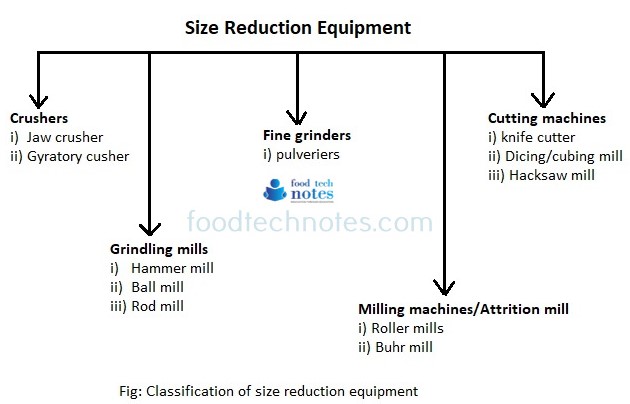
There are various size reduction equipment and have different principle. The common working principles in food industries are slicing (as in preparing potato chips), dicing (cutting into cubes), shredding (shear force as in wheat milling), grinding (impact force as in making spice powder), crushing and pulping (as in fruit juice extraction). However, size reduction equipment are not only used in food processing industries. It is also widely used in construction industries. Common examples are; Jaw crusher and Gyratory crusher.
It is controlled germination process that activates enzyme of resting grain resulting in the conversion of cereal starch to fermentable sugar and partial hydrolysis of protein and other macromolecule. During malting, large molecular weight components of endosperm cell walls, the storage protein and starch granules are hydrolyzed by enzymes rendering them more soluble in water. All cereals grains are capable of undergoing malting barley is the best. Barley is best for malting because, the husk tightly protect the endosperm and developing germ. Also husk aids as filtration aids dring brewing and making extraction easy. The most suitable type of barley for malting are Read more
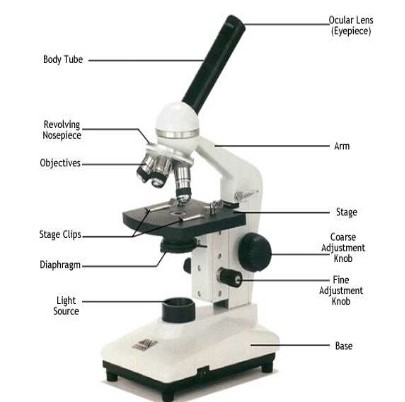
Microscope is an optical instrument consisting of lens for making enlarged or magnified images of minute objects. Robert Hook (1635 – 1703) made and used a first compound microscope. The basic difference between simple and compound microscope is that simple microscope uses only one lens whereas, compound microscope uses more than one lenses to further magnify the object.
Fig: compound microscope
The ability of microscope to distinguish two adjacent object as separate and distinct images rather than single blurred image is called resolving power of microscope. Theoretically, size of image can be increased by adding lenses. Magnification of object is only useful if the enlarged image is clearly visible. So, effective magnification depends on resolving power of microscope.
A microscope’s resolving power is dependent on wavelength of beam for illumination and optical quality of lenses. Shorter wavelength gives better resolution. Resolution or shortest distance (d) can be calculated by using the formula, d = λ/2nsinϴ where, d = resolution, λ = wavelength of light, n = refractive index and ϴ = angle subtended.
Note: Oil is used with oil immersion lenses because it has higher numerical aperture than air and also higher refractive index and this greatly improves resolution. Read more
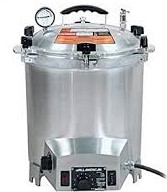
Autoclave: Autoclave is a sealed devise that allows the entrance of steam under pressure. The use of moist heat facilitates killing of all microorganisms including heat resistance endospores. The underlying principle is, with increase in steam pressure, the temperature also rises. The water boils at 100°C upon the vapor pressure of atmosphere. Temperature will increase if vapor pressure is increased. The autoclave is operated at 15lb/inch2 for 30 minutes. This temperature for a period of 30 minutes is sufficient to kill all the vegetative and spore cells of microorganism. Pressure temperature relationship is given as Read more